

News

Africa PID Alliance Strengthens Research Transparency Through RRID Integration Into DOCiD™
Nairobi, Kenya — 13 May 2026 (Source: Africa PiD Alliance)
The Africa PID Alliance has finalized the technical integration of Research Resource Identifiers (RRIDs) into the DOCiD™ infrastructure to enhance the global traceability of African research resources. While many persistent identifiers focus on the final publication, RRIDs provide unique tags for the actual ingredients of science, including antibodies, model organisms, and software, securing the provenance of the specific tools and materials used by researchers across the continent.
A primary outcome of this rollout has been providing the core or shared facilities within Africa, namely the World Bank African Centres of Excellence (ACE), with the technical autonomy to verify their own research assets. By embedding RRIDs into the DOCiD™ metadata schema, these facilities can formally document the exact resources behind their findings, creating a persistent link between physical lab materials and their digital identifiers. For example, a shared genomics facility can now associate validated RRIDs with specific software pipelines, reagents, or instruments used in published studies. This is a critical step toward improving reproducibility, increasing global visibility of African research resources, and enabling institutions to manage and validate their own research infrastructure.
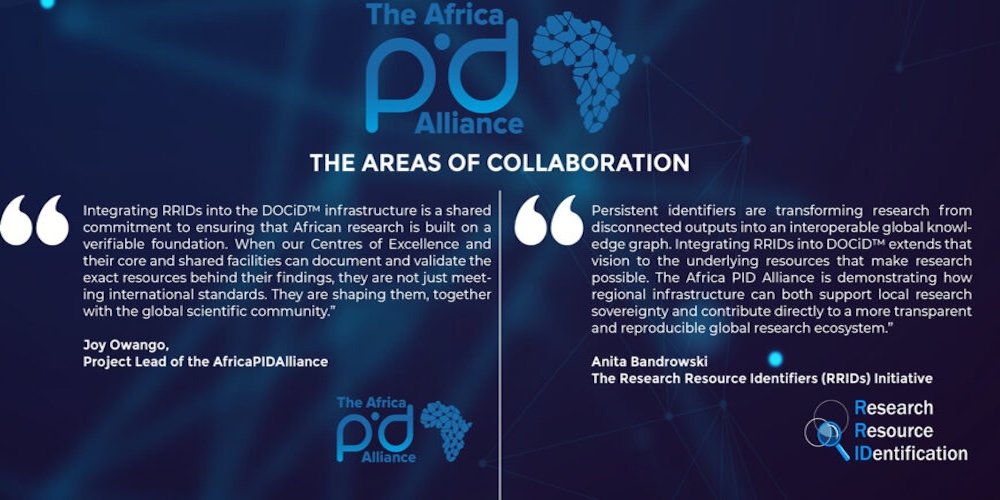
“Integrating RRIDs into the DOCiD™ infrastructure is a shared commitment to ensuring that African research is built on a verifiable foundation. When our Centres of Excellence and their core and shared facilities can document and validate the exact resources behind their findings, they are not just meeting international standards. They are shaping them, together with the global scientific community,”
— Joy Owango, Project Lead, Africa PID Alliance (APA)
“Persistent identifiers are transforming research from disconnected outputs into an interoperable global knowledge graph. Integrating RRIDs into DOCiD™ extends that vision to the underlying resources that make research possible. The Africa PID Alliance is demonstrating how regional infrastructure can both support local research sovereignty and contribute directly to a more transparent and reproducible global research ecosystem.”
— Anita Bandrowski, CEO of the Research Resource Identifiers (RRIDs) Initiative
The technical deployment of these identifiers within DOCiD™ enables African researchers and core facilities to precisely document and reference the resources, tools, and materials underlying their methodologies, whether the study is in agriculture, environmental science, or the life sciences.
About the Research Resource Identifiers (RRIDs) Initiative
The Research Resource Identifiers (RRIDs) initiative promotes the identification, discovery, and reuse of key research resources, including antibodies, model organisms, cell lines, software tools, databases, and other scientific resources. RRIDs are persistent, unique identifiers that help researchers unambiguously cite the resources, tools, and materials used in scientific studies, improving reproducibility, transparency, and resource tracking across the research ecosystem.
By standardizing the citation of research resources, RRIDs support more accurate reporting, easier replication of findings, and greater visibility for the scientific resources and core facilities that underpin research worldwide.
For more information on the Research Resource Identifiers (RRIDs) Initiative, visit: https://www.rrids.org/
About the Africa PID Alliance
The Africa PID Alliance is dedicated to securing the future of African innovation, indigenous knowledge, and cultural heritage. Through the provision of reliable open research infrastructure services, the alliance enables access to knowledge and metadata about digital objects, with a strong emphasis on Africa’s unique contributions to global research. The Africa PID Alliance is the Open Infrastructure program of the Training Centre in Communication ,
For more information on the Africa PID Alliance, visit https://africapidalliance.org/
About DOCiD™
Digital Object Container Identifier (DOCiD™) is a Fair Digital Object developed by Training Centre in Communication (TCC Africa) that applies a multilinear approach to generating African-originated Persistent Identifiers (PIDs) for research outputs. DOCiD™ is also a persistent, unique identifier assigned to a digital container that aggregates multiple research outputs, datasets, or related scholarly content. Unlike traditional identifiers that target a single object (like a DOI for a paper), a DOCiD™ enables the tracking, linking, and management of collections of research assets, facilitating interoperability, discoverability, and reuse across systems.
It is an open infrastructure initiative dedicated to strengthening the visibility, sovereignty, interoperability, and global discoverability of African knowledge systems and scholarly outputs.
In practice, DOCiD™ is used to:
Unambiguously identify research containers—collections of datasets, code, protocols, or publications.
Support metadata-rich management—ensuring that all components within the container are visible, citable, and linked.
Enhance integration with PIDs across institutions—allowing African research organizations to connect with global research infrastructures .
Enable reproducibility and transparency—by capturing the context and relationships between related research outputs in a single, persistent container.
DOCiD™ is Africa PID Alliance’s solution for persistent identification and management of complex research objects, promoting open science and structured data sharing across African research ecosystems.Example of a live DOCiD™ for individual researchers – DOCiD™ APP
For more information on the DOCiD™ visit: https://docid.africapidalliance.org/about-us